Interpreting is often described as a language service, but in professional environments, language is only one part of the equation. The subject matter of a discussion shapes how information is delivered, what is left unsaid, and how meaning is constructed between participants who share a common professional framework.
Industry-specific interpreting refers to assignments where interpreters are familiar with the field in which communication takes place. This familiarity includes terminology, procedural structure, and the way professionals in that industry typically speak, question, and respond. Without this context, interpretation may be linguistically accurate but operationally incomplete.
In medical, legal, technical, and regulated settings, subject matter expertise is not a refinement. It is a condition that supports clarity, efficiency, and reliability.
The Limitations of Generalist Interpreting
Generalist interpreters are often effective in settings that rely on common vocabulary and straightforward communication. Challenges tend to arise when assignments involve technical language, procedural complexity, or sustained, high-density discussion.
Common limitations include:
- slower interpretation when technical terms or unfamiliar concepts appear;
- increased need for repetition or clarification from speakers;
- difficulty tracking layered questions or rapid exchanges; and
- inconsistent handling of terminology that has precise or field-specific meaning.
These issues can affect the pace and clarity of a meeting, hearing, or negotiation. Participants may need to pause, restate points, or adjust how they speak, which can interrupt proceedings that are otherwise structured and time-sensitive.
This situation reflects a planning consideration rather than any issue with performance. Interpreters cannot rely on intuition alone when subject matter knowledge is missing. Assignments involving specialized content require preparation and experience aligned with the field.
What Specialized Interpreters Contribute
Specialized interpreters bring contextual awareness that supports accurate interpretation under real working conditions. Their familiarity with industry language and professional norms allows them to follow discussions as they naturally unfold.
This contributes to:
- consistent rendering of technical terminology;
- accurate handling of acronyms, abbreviations, and shorthand references;
- ability to keep pace with structured or fast-moving dialogue;
- reduced need for interruption or clarification; and
- greater continuity across extended or multi-session assignments
Importantly, subject matter expertise does not change the interpreter’s role. Interpreters do not explain, correct, or supplement content. Their responsibility remains to convey the speaker’s message faithfully. Subject matter familiarity simply allows them to do so with greater precision and efficiency.
Examples of Industry-Specific Interpreting in Practice
Certain professional environments consistently require interpreters with subject matter experience due to the nature of the communication involved, such as:
- Business negotiations and commercial meetings, particularly those involving contracts, financial terms, compliance considerations, or strategic planning;
- Regulatory, compliance, and audit-related discussions where communication relies on defined frameworks, procedural steps, and precise terminology such as clinical trials or financial audits;
- Technical trainings and professional conferences involving engineering concepts, software systems, manufacturing processes, or operational workflows that are rarely explained in plain language; and
- Depositions and legal proceedings that involve procedural language, rapid questioning, and terminology which carries legal consequence.
In each of these contexts, interpreting quality is closely linked to the interpreter’s familiarity with the subject matter and professional context. A solid understanding of the field’s terminology, conventions, and typical modes of expression results in accurate, clear, and contextually appropriate communication.
Why This Matters for Planning
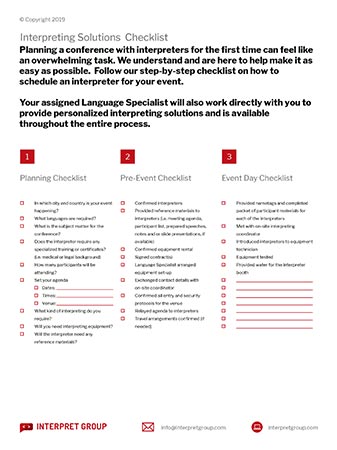
Interpreting assignments are often planned around language pairs, modality, and scheduling. Subject matter is sometimes treated as secondary. In practice, it should be considered alongside these factors.
When interpreters are matched to the subject matter:
- discussions proceed more efficiently;
- participants communicate with greater confidence;
- the likelihood of misunderstanding is reduced; and
- less time is spent correcting or restating information.
This becomes essential in settings where records, decisions, or outcomes depend on precise communication.
Subject Matter Expertise as a Standard
When discussions involve medical decisions, legal rights, regulatory obligations, or technical outcomes, interpretation directly affects what is understood, recorded, and acted upon.
Language accuracy alone is not sufficient. Interpretation that lacks subject matter alignment can slow proceedings, disrupt continuity, and increase the risk of misunderstanding, even when individual terms are rendered correctly.
For organizations planning interpreting support, the relevant question is not whether specialization is reserved for exceptional cases. It is whether the assignment involves professional judgment, technical content, or regulated outcomes. In those settings, subject matter alignment should be treated as a baseline requirement. Interpreting is most effective when it is planned, staffed, and managed with the same level of rigor applied to the proceedings it supports.