When interpretation is done well, it often goes unnoticed. Conversations flow naturally. Speakers feel understood. Decisions move forward without friction. It can seem effortless.
That ease is not accidental. Behind every seamless multilingual exchange is a significant amount of preparation that rarely gets seen.
Professional interpretation is not simply about speaking two languages. It is about understanding context, anticipating meaning, and delivering accuracy in real time. That level of precision depends heavily on what happens before the first word is even spoken.
Why Preparation Is Non-Negotiable
In high-stakes environments such as large‑scale international conferences, multi‑day summits, and long‑running cross‑border initiatives, interpretation is integral to how the event functions. It must be planned, resourced, and coordinated with the same care as production, technology, and program design.
A single mistranslation can shift meaning, alter tone, or introduce ambiguity. When terminology is specialized or discussions move quickly, interpreters cannot rely on improvisation. Preparation is what allows them to keep pace while maintaining accuracy.
Well-prepared interpreters do more than translate words. They interpret intent, nuance, and technical meaning, all while keeping the conversation natural and coherent for all parties involved.
Building Terminology Through Glossaries
One of the most critical elements of preparation is the development of glossaries.
A glossary is not just a list of translated words. It is a curated set of terms, phrases, and concepts specific to the subject matter of a meeting or event. This can include industry jargon, acronyms, product names, legal terminology, or even organization-specific language.
For example, at an international conference or multi‑day summit, recurring concepts such as program themes, session tracks, policy frameworks, or research methodologies must be translated consistently across panels and days. In a technical engineering meeting, product specifications or system components may not have direct equivalents unless properly researched in advance.
Interpreters build and refine these glossaries before the session. This ensures consistency across the entire engagement and reduces hesitation during live interpretation. It also allows interpreters to focus on delivery rather than searching for the right term in the moment.
Investigation and Contextual Research
Beyond terminology, interpreters conduct deeper investigation into the subject matter.
This includes understanding the purpose of the meeting, the background of the participants, and the broader context of the discussion. Are the speakers negotiating a contract, presenting research findings, or resolving a dispute? Each scenario requires a different level of formality, tone, and precision.
Contextual research may involve reviewing past communications, studying industry trends, or familiarizing themselves with relevant regulations or frameworks. In multi-day summits, this includes understanding the structure of the program, the roles of speakers and moderators, and how sessions build on one another. In corporate environments, it may involve learning about the company’s products, services, and internal language.
This investigative work allows interpreters to anticipate how conversations will unfold. It reduces the risk of confusion and ensures that meaning is conveyed accurately, even when discussions become complex or fast-paced.
The Role of Preparatory Materials
Preparatory materials are one of the most valuable resources an interpreter can receive.
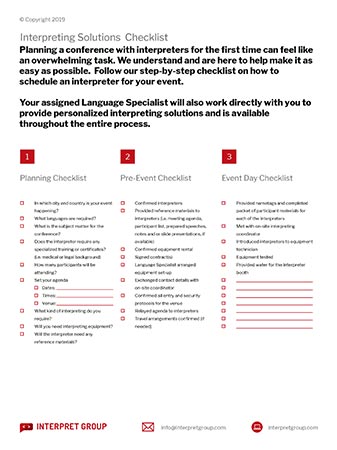
These may include agendas, run-of-show documents presentation slides, contracts, reports, speaker bios, or any documentation that will be referenced during the session. Even partial materials can make a significant difference.
Access to these documents allows interpreters to familiarize themselves with key concepts, identify potential challenges, and align their terminology in advance. It also helps them understand the structure of the discussion, including when technical sections, Q&A segments, or critical decision points are likely to occur.
Without preparatory materials, interpreters are forced to react in real time with limited context. With them, they can operate with foresight and confidence.
For organizations, sharing materials in advance is one of the simplest yet most effective ways to enhance interpretation quality and ensure accurate message delivery. This shift transforms interpretation from a reactive function into a strategic asset.
Briefing Meetings: Aligning Expectations
Briefing meetings are another essential but often overlooked part of the preparation process.
These sessions allow interpreters to connect directly with clients, speakers, or event organizers before the engagement. The goal is to clarify expectations, address potential challenges, and align on key details.
During a briefing, interpreters may ask about:
- The objective of the meeting or event
- The background and roles of participants
- Specific terminology or sensitive topics
- Preferred tone or level of formality
- Any anticipated complexities or areas of focus
This exchange of information helps eliminate uncertainty. It also creates a collaborative environment where interpreters are treated as communication partners rather than passive participants.
When briefing meetings are part of the process, interpretation becomes more precise, more consistent, and better aligned with the needs of the audience.
Preparation as a Quality Multiplier
All of these elements, glossaries, investigation, preparatory materials, and briefing meetings, work together to elevate interpretation quality.
They reduce hesitation, improve consistency, and allow interpreters to deliver with clarity and confidence. More importantly, they protect the integrity of the message being communicated.
In multilingual settings, accuracy is not just about words. It is about ensuring that every participant receives the same meaning, tone, and intent, regardless of language. Preparation is what makes that possible.
A More Strategic Approach to Interpretation
For organizations operating across languages, interpretation should not be treated as a last-minute logistical detail.
It is a critical component of a well crafted cross-border and cross-cultural communication strategy, that benefits significantly from early planning and collaboration. Engaging professional interpreters early, providing materials in advance, and scheduling briefing sessions are small steps that lead to significantly better outcomes.